
Negative review
Negative Google review: reply, report or stay silent
When to report a review, when to reply and admit a mistake, and why silence hurts most. A decision tree, Google’s advice and an example reply.
Updated
You should almost always reply to a negative Google review. If it breaks Google’s policies (a fake, a competitor’s review, abuse, personal data), report it and reply briefly and calmly while Google reviews the report. If the problem is real, admit it, say what you have changed and invite them to talk. If the facts are unclear, thank the reviewer and ask for details privately. Do not stay silent: future customers will see the review, and the only way to have it removed is to report it.
How to decide: reply, report or stay silent
Ask yourself two questions in this order: does the review break Google’s policies, and is the problem it describes real?
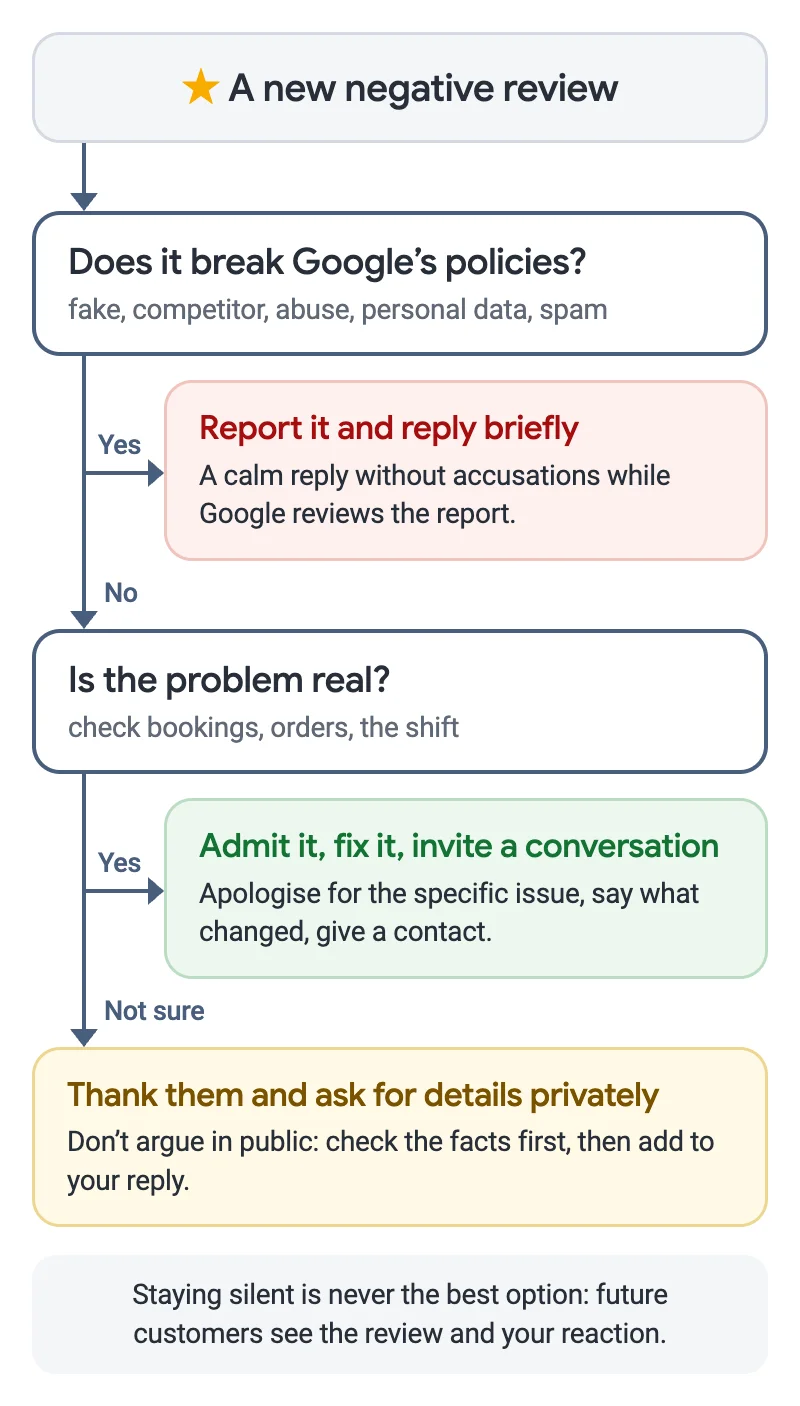
A harsh tone, a single star or a rating you consider unfair does not break the policies on its own. Google does not remove reviews just because you disagree with them, so reporting fair criticism achieves nothing, and the time for a reply passes.
When to report a negative review
Report a review if it is fake or misleading, was written by a competitor, an employee or the owner, contains abuse, hate speech or someone’s personal data, or is not about your business. The full list of grounds, the steps and the report statuses are in our guide on how to report a fake Google review.
A report does not replace a reply. Google usually takes a few days to review a report, and everyone can see the review in the meantime. A short reply without accusations shows that you do not ignore customers, even if the review is removed later.
When the review is honest criticism
If your records, orders or a conversation with the staff on shift confirm the problem, admit it publicly. Google advises acknowledging your mistakes and apologising where needed, but not taking responsibility for things you do not control.
- Name the problem in the customer’s words: “waited too long for the order”, not “an unpleasant situation”.
- Say what you have changed or will change, but only if it is true.
- Give a way to continue the conversation: the business’s phone number or email address.
If the facts are unclear, for example there is no such visit in your records, do not argue in public. Thank the reviewer, ask them to contact you and update your reply once you know the details. Google explicitly advises inviting the reviewer to contact you directly.
Why staying silent is the worst option
Silence does not remove the review: a profile owner cannot delete someone else’s review, only report it. A review without a reply looks like an open complaint, and future customers see both the review and your reaction. In BrightLocal’s 2026 survey of 1,002 US adults:
- 89% of consumers expect businesses to reply to reviews;
- 80% would rather choose a business that replies to all reviews;
- 42% are unlikely to choose a business that never replies.
These are US figures: we found no Ukrainian survey on this topic.
How to reply to a negative review: Google’s advice
In its help pages on reviews, Google advises you to:
- write politely, concisely and without personal attacks;
- avoid revealing information about the reviewer;
- find out what caused the negative experience and offer to talk directly;
- be honest and explain any limitations;
- acknowledge your mistakes and apologise where needed;
- personalise the reply and sign it with your name or initials;
- reply promptly.
How long you have to reply is covered in our guide on how fast to reply to Google reviews.
An example reply to a negative review
A 2-star review: “Waited 25 minutes for coffee and the barista didn’t even apologise. Not coming back.”
Olena, thank you for writing, and we are sorry about the 25-minute wait: that really is too long. On Saturday morning only one barista was on shift; at weekends there are now two. If you would like to talk about your visit, please call us on the number in our profile. Andrii, café manager.
An illustrative example, not a real review or a reply from a real business.
What works here: the problem is named specifically, the apology is for that problem rather than a vague “sorry for any inconvenience”, the reply says what has changed, and it gives a contact and a signature.
What not to do in a reply
- Do not argue or publicly accuse the reviewer of lying.
- Do not reveal customer data: what they ordered, their phone number or surname, even if you recognise them.
- Do not offer a discount or a gift for deleting or changing the review: Google treats this as artificially inflating ratings and strictly prohibits it.
- Do not mention offers or promotions in the reply.
- Do not post the same reply under every review: 50% of consumers are put off by template replies (BrightLocal 2026, US).
What happens after you reply
When you reply, Google notifies the reviewer. They can edit the review, and it will then show the date of the latest edit. The reply is published under the business name; your own name is not shown. Google checks replies before publishing them, which usually takes up to 10 minutes but can sometimes take up to 30 days. You can edit or delete your reply.
If the problem is resolved, the customer may update their review themselves. If they do, add one sentence to your reply.
To make sure you do not miss a negative review, MapsReply notifies you about new reviews and prepares a draft reply in your business’s tone. Reviews of 1–3 stars wait for your approval by default. More about MapsReply.
Frequently asked questions
Should I reply to every negative review?
Yes, even if you have reported the review: while Google is looking at the report, everyone can see the review, so a short, calm reply is better than silence.
Can I delete a negative Google review?
A profile owner cannot delete someone else’s review. After a report, Google removes only reviews that break its policies. The reviewer can edit or delete their own review.
Can I ask a customer to change their rating?
You can offer to put the problem right, but you must not give discounts, gifts or other rewards for changing or deleting a review: it is against Google’s policies.
How do I reply if there is no such visit in my records?
Thank the reviewer, say you found no visit with those details and ask them to contact you. If the review looks fake, report it to Google as well.
Sources
- Tips to get more reviews, Google Business Profile Help.
- Manage customer reviews, Google Business Profile Help.
- Prohibited and restricted content, Maps user-generated content policy.
- Local Consumer Review Survey 2026, BrightLocal, 1,002 US adults.
The advice was checked against Google’s help pages on 5 November 2026.