
Review rules
Buying or faking Google reviews: what a business risks
What Google treats as fake reviews, which restrictions a profile gets, how bought reviews are noticed and how to get reviews honestly.
You can buy or fake Google reviews within a few days, but Google’s policies forbid it. Google removes paid, incentivised and insider reviews, and a profile may, for a period of time, stop receiving new reviews, have existing ones hidden or show customers a notice that fake reviews were removed. Below: what counts as fake engagement, how it ends and how to get reviews honestly.
What Google treats as fake reviews
Google’s policies require a review to describe a genuine experience. It is not allowed to:
- pay for a review with money, goods, services or a discount, including for changing or removing a negative review;
- buy reviews from agencies, Telegram channels or freelancers paid per review;
- review your own business as the owner, staff, relatives or from several accounts;
- ask only happy customers for reviews or discourage negative ones;
- set staff targets for the number of reviews or pressure customers on the spot;
- post negative reviews about competitors.
More on discounts and gifts for reviews: what is allowed and what is not.
What happens to the profile if Google finds fake reviews
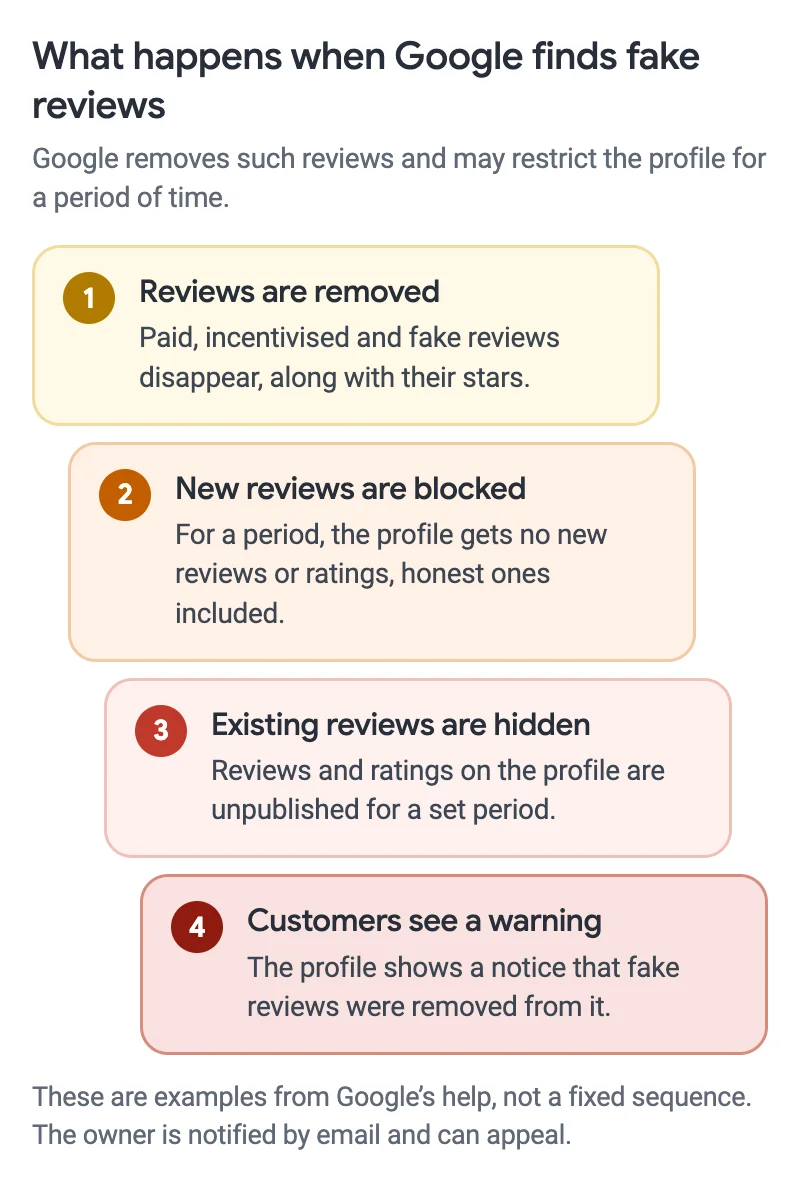
Google removes reviews that break its policies and may restrict the profile: for a set period it may not accept new reviews and ratings, unpublish existing ones or show customers a notice that fake reviews were removed. These are examples from Google’s help, so other measures are possible.
The owner is notified of a restriction by email. If the decision is wrong, it can be appealed: Google reviews the profile again and reports the outcome.
How bought reviews get noticed
Google specifically mentions unusual volumes and patterns of reviews as a sign of manipulation. Customers read reviews closely too, and bought ones look different from real ones:
- dozens of reviews within a few days after months of silence;
- reviewers with new accounts and no other reviews or photos;
- similar texts without details: no stylist’s name, no dish, no service;
- only five stars and not a single remark;
- reviews the business never replies to.
Why buying reviews does not pay off
The scale of enforcement is large: in 2025 Google blocked or removed over 292 million policy-violating reviews and over 13 million fake business profiles. A bought review only has to be caught once for the money to be lost, and honest reviews may suffer with it if the profile is restricted.
Even before that, bought reviews do little for sales: they lack the details customers look for, and the gap between five stars and the real service soon shows in new negative reviews.
It is not only Google that bans bought reviews
In the US, a Federal Trade Commission (FTC) rule in force since 21 October 2024 bans creating, buying and selling fake reviews, including AI-generated ones. In the EU, Directive 2019/2161 explicitly bans commissioning fake reviews and claiming reviews come from real customers without reasonable checks. If you have customers in these markets, the risk is no longer just reputational.
How to get more reviews honestly
- Ask every customer for a review, not only happy ones, once the service is done.
- Give a direct link or QR code at the till, on the receipt, in a message or on a sign.
- Reply to every review: customers see that reviews are read.
- Promise nothing in return for a review, not even a discount.
How to ask for a review and where to get the link is covered in the guide how to collect Google reviews, and reply examples are in replying to reviews: examples.
MapsReply notifies you about new reviews, prepares a reply in your business’s tone and helps you make a QR code that leads straight to the Google review form, without filtering ratings. More about MapsReply.
If someone fakes reviews against you
It also happens the other way round: a competitor orders negative reviews about you, or someone demands money or a discount under the threat of bad reviews. Such reviews can be reported: how to remove a Google review. Google has separate help on reporting extortion; the link is in the sources below.
Frequently asked questions
Can I buy Google reviews safely?
No. Any payment for a review breaks Google’s policies, whoever writes it and whatever it costs. Sellers who promise “safe” reviews cannot guarantee that Google will not remove them.
Can I ask friends to leave a review?
If a friend really was your customer, they can describe their experience. Staff, former staff and relatives must not review your business: that is a conflict of interest.
Can I pay an agency to collect reviews?
Paying for reminders to customers and a link to the review form is fine. If the agency writes reviews itself, pays reviewers or promises a number of five-star reviews, that is fake engagement.
Will Google remove old bought reviews?
Google can remove a policy-violating review at any time, not only right after it is posted. So old bought reviews remain a risk.
What if a restriction was applied by mistake?
File an appeal with an explanation and evidence of genuine visits. Google reviews the profile again and tells you whether the restriction was lifted.
Sources
- Fake engagement: Maps user-contributed content policy, Google Maps.
- Business Profile restrictions for policy violations, Google Business Profile Help.
- Report extortion attempts through negative reviews, Google Business Profile Help.
- New ways we’re protecting businesses on Maps, Google blog, 2025 data.
- Final rule banning fake reviews and testimonials, FTC, 2024.
- Directive (EU) 2019/2161, EUR-Lex.
The policies were checked against Google’s help on 5 November 2026. This article is not legal advice.